Showing posts with label creativity. Show all posts

Friday, April 1, 2016

Emerging Creatively

It's a blogosphere cliche to make the obvious comment that it's been a while since I've posted. Between being hit by a couple of severe illnesses and some internal struggles, I've been at best unfaithful to my goals for this site. 

Nevertheless I'm regaining the desire to fight back and resume my purpose in establishing this blog. Which is really kind of the point of my designation for this year being dedicated to completion/ follow through of projects, goals and aims. 

I was inspired today by a TEDTalk given by Elizabeth Gilbert, primarily known for her book, "Eat, Love, Pray." I'd heard her on a radio chat show talking about the mystery of creativity/genius but I hadn't heard the entire presentation as presented here. 


I love her take on the creative process and the conclusions she puts forward to just keep showing up and do what is your responsibility to do and leave the inspiration to show up or not. Do your part and do it to your highest ability. That's all you have control over. 

Take a listen and see if she doesn't inspire you, too. 

Friday, February 12, 2016

Inspiration

Jack London said, "You can't wait for inspiration, you have to go after it with a club."

@Hey-Jamie posted on Twitter, "Inspiration is a funny thing. Sometimes it chases you and sometimes you have to chase it."

Jim Carey said, "Life opens up opportunities to you and you either take them or you stay afraid of taking them."

How you expect to interact with inspiration - waiting for it to hit, going to get it or recognizing when it pops up and taking the plunge - dictates your creative life. 

Monday, February 8, 2016

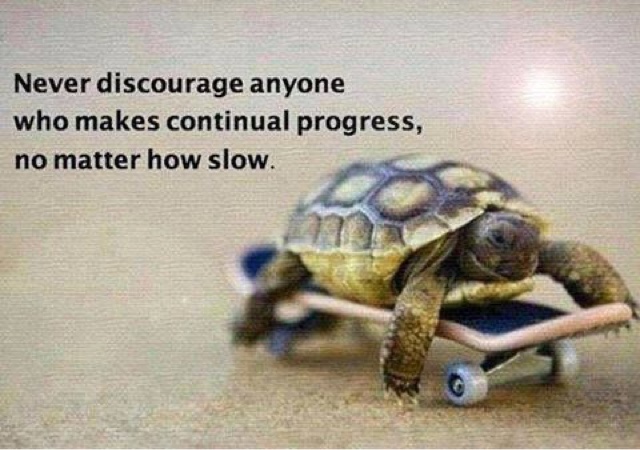
Speed of change

I saw this image today when I was searching for images to use for a slide that is going to talk about progress made on a project and it resonated with me so much I wanted to share. 


I don't know about you but I get impatient. When I decide to do something, I just want to do it and be done. Unfortunately things don't always work like that. 

Sometimes it takes laying foundations (learning new skills, understanding history, putting things in context) to accomplish goals. 

Sometimes it takes building layer by layer (strengthening relationships, clarifying direction, making adjustments). 

Sometimes it takes time to finish properly to seal the progress so that it stands the test of time and use. 

Those sometimes take time. I have to remember that, even if progress is slow, it's progress. This has become my year of completion. I have a number of projects that have languished or been allowed to fall by the wayside. My goal this year is to break through and complete these projects that, to be honest, aren't going to be earth shattering except to my personal life and self esteem. But that's reason enough to progress, however slowly that might happen. 

Tuesday, February 2, 2016

Stumbling Blocks

When you're trying to live a creative life, there are plenty of things that will try to stand in your way. What I'm discovering is that often the most effective stumbling blocks are the ones I put in my own way.  As I attempt to step out in areas of my life, I have every intention of following through.  I can see myself doing that thing but I realize that I'm very good at sabotaging myself.

It's not important to go into details here of why that's happening but I'm realizing that I jolly well better figure out why I'm doing it or I'm not going to be able to fulfill my own dreams and fully spread my wings.

What about you?  Do you have good intentions to accomplish a goal but find yourself falling short? There could be reasons such as needing to increase your skill level or making the right contacts.  But it may be that  you're getting in your own way.

I've decided that this is my year to face my self-sabotage and overcome it so the things I've been dreaming of can find their way to the light of day.  I suspect it's going to be a hard year full of soul searching but if I can find my way, it will all be worth it.

Saturday, January 16, 2016

Something new

I was talking to a friend today that was telling me about this new gadget she'd gotten and as she was telling me about how it works, I was reminded about how many obscure interests there are out there that people share and that I didn't even know existed. 

Finding out about people or activities you have no knowledge of is kind of random but you can use social media to hit on these kinds of things. 

Poke around and join a couple of groups or follow some people and learn about a topic you know nothing or very little about. Pay attention to the vocabulary and the things the practitioners take for granted. What's most surprising about the knowledge they're sharing?  How does it compare to your preconceptions? What's something you can take away from their skills or activities?

Here are some random subjects or find your own…

Tatting
Silhouette cutting
An era of history
History reenactment
What went on today in a country you've never visited? (Not necessarily a hot spot, just a random day for ordinary people)
Follow some feeds in a city you've never been in. What are people there caring about today?
Tuba musicians
Architects and architecture
Library science
How does the pancreas work?
What went on at the Black Comic Book Festival today?
How does a camera work?

Friday, January 15, 2016

Creativity and Books

As I was reading the various reactions and posts last week after the passing of David Bowie, two of the things that stood out to me were his enormous creativity and his voracious reading habits. I've never been a huge Bowie fan but I think I can learn a few things from his life. His creativity in multiple spheres speaks for itself. 

In 2014, he created a list of 100 of the books that most influenced him. You can find the list in various places, and a Facebook page has been set up to start a book club for those wanting to work through the list, but here's a link to give you a view: http://www.nypl.org/blog/2016/01/11/david-bowies-top-100-books

This topic also made me start thinking about what would be on my list. Almost every highly innovative, creative person is also a reader. In our environment, that could mean books, online posts, forums, etc. but they read.  They fill their mind with new ideas that challenge their perceptions of the world around them and their internal thoughts. 

Not that long ago, books were burned because it was assumed they would undermine the status quo. Remember, you can (and I argue you should) read books that present views that you don't agree with.  This is where you take a look from the other side of an issue, use your brain to evaluate what you read and then make up your mind. 

If you would like to be more creative read, read, read. 


Tuesday, January 12, 2016

The Creativity of Agatha Christie

I was listening this morning to an Agatha Christie book on tape (you have to listen to the ones recorded by Joan Hickson - she IS Miss Jane Marple) and I was struck at how Miss Marple employed lateral thinking in her deductions.

Lateral thinking - a way of solving problems by rejecting traditional methods and employing unorthodox and apparently illogical means; an unorthodox approach to problem-solving, often looking at problems from other 'sides' rather than head-on.

In the story I was listening to this morning, the victim had been a silly superstitious woman who had met with a medium who told her that when a certain flower on the wall turns blue, she will die.  She drew on her previous experience as a nurse to determine that the nurse had used litmus paper to cover the flower on the wall from pink to blue as camouflage to draw attention away from the murder.  She also tied the current problems they were having with their district nurse whose attentions were spurned by a resident, which caused her to turn on him and try to blacken his name.

Her solutions were like picking flowers in the garden.  She takes one experience that reminds her of some portion of the situation and then another that makes her think of another person who caused problems in another way and so on until she has a bouquet that wraps up the criminal with a bright ribbon.  Sometimes it was something to do with gardening, sometimes it was a person she knew from her village, sometimes it was a fact about keeping house, sometimes it was an experience from her past, sometimes it was her knowledge of human nature.  It was all grist to her mystery-solving mill.

I encourage you to listen to Miss Marple with new ears.  Let her lateral thinking challenge you to stretch your thinking all around your experiences and random facts and knit them together into a fluffy white solution to your mystery.

Today just happens to also be the 40th anniversary of Agatha Christie's death.  OED posted today, "12 January is the anniversary of the death of Agatha Christie, a doyenne of the whodunnit, or as the celebrated humorist Ogden Nash put it, a murdermongress.  In a career spanning 50 years, she wrote over 60 detective novels, as well as collections of short stories and plays.  In addition, she indulged her romantic side by writing a number of novels in the romance genre, under the pseudonyn Mary Westmacott."

RIP Agatha Christie and thanks for sharing your creativity.


Sunday, January 10, 2016

Seasons

We'd all love to be creative all the time, in every circumstance.  We would love to have creativity overflowing from our fingertips so that everything we touch explodes into the world.  As I sit in my lovely warm house with the temperatures below zero outside and snow laying on the ground, I'm reminded of the seasons.  There are seasons in nature and seasons in our lives.

Our temptation is to be continually "on."  Our technology allows us to connect with the world around us 24/7 but if we let that mindset run our lives, we'll soon be on empty.

One of the things I've learned in life the hard way is that we have inner resources of energy.  When those resources are depleted, everything becomes hard and tiring and wears us down.  Even things we would normally be fine with become chores that we do because we have to, not because we want to.

I've talked in an earlier post about how we can identify activities that will help us build these reserves back up but I'd like to add to those activities (for me music and textile arts) the basics of rest and input.  To give out, you have to have something to give.  To have something to give, you have to take in.

I encourage you to take time to rest (physical, mental and emotional rest) and to take in information that can become fuel for your creative life on purpose.  I realize that those things sometimes feel out of reach, especially if you're a new parent or a parent of a special needs child.  At those times, you feel like you'll never be rested again.  Ever.  I don't want to be dismissive of the demands on your time and energy in this season of life and I don't want to be simplistic.  You need to understand your season and do what you can to take care of yourself.  Or maybe you need to allow others to take care of you.  Sometimes, that's the more difficult move.

Thursday, January 7, 2016

There's no substitute for practice

People want to start something and immediately be proficient but if they can't, they don't want to try. 

How you view the need to practice skills, including the use of creative thinking, will determine your attitude and how people embrace your ideas. 

Coming at something from a sense of superiority (I have to be better than everybody or I will lose face) is something people will generally pick up on and reject. Sometimes a sense of superiority is simply the wrong sort of pride that can't bear to be found insufficient at something. Well, you know what?  You may be insufficient at a skill you would like to master but that can be fixed. Practice. 

By the way, practice doesn't always make perfect but it can certainly make you better. But before you get better at a skill, you have to start and be willing to suck at it. It's just the way it works. But there can be a freedom in doing something you're not good at (yet). You can just relax and get jiggly with it and have some fun while you're learning. 

Approach the new skills you want to master with a sense of fun and play. You'll be amazed at how much easier it is to learn when you're laughing!

Wednesday, January 6, 2016

Negative Influences

As I said before, we are influenced by what we love and what we hate.  Hate can be sometimes be and even stronger influence on our lives than love.  This applies at many different levels.

Hate (anger turned out) and depression (anger turned in) are both issues we all have to deal with.

A person wrongs me and makes me angry.  My hate/anger towards that person will influence how I deal not only with that person but with any other person that I perceive to be "painted with the same brush." Holding on to hate or anger, withholding forgiveness, although it sounds trite, only damages you and influences you in a way that causes you to make unhealthy choices. Depending on its strength, it affects your relationships, your physical health and your emotional and spiritual well-being.  Here are some quotes about forgiveness to ponder.  Don't skirt over them but actually read them out loud and think about what they're saying.  Holding on to a slight because it's yours poisons your ability to create beauty.  No matter what, it will steal from you and do no damage to the object of your hate, thus defeating the purpose.

"The weak can never forgive.  Forgiveness is the attribute of the strong." Mahatma Gandhi

"We must develop and maintain the ability to forgive.  He who is devoid of the power to forgive is devoid of the power to love. There is some good in the worst of us and some evil in the best of us.  When we discover this, we are less prone to hate our enemies." Martin Luther King, Jr.

"Forgiveness is a funny thing.  It warms the heart and cools the sting." William Arthur Ward

"It's one of the greatest gifts you can give yourself, to forgive.  Forgive everybody." Maya Angelou

"Forgiveness is not always easy. At times it feels more painful than the wound we suffered, to forgive the one who inflicted it. And yet, there is no peace without forgiveness."  Marianne Williamson

Hate towards ourselves results in self-talk that goes something like this:

  • "You're so stupid.  Why did you say that?  That's stupid and now that person knows how stupid you really are."
  • "You're a clutz.  You'll never be anything but clumsy."
  • "You're unlovable.  No one can ever love you, at least not if they ever get to know you.  They're saying the right words but wait until they find out who you really are."
  • "You're ugly.  Your body is disgusting.  You can't ever let anyone see your body because they'll just be disgusted."
  • "You can never get anything right.  What are you even still doing here?"
  • "You're no good at that.  You're never going to be able to do it right so why even try?"
  • "You'll never be able to persevere.  You're too wishy-washy for that.  You fail at everything and you're going to fail at this, too.  Don't even waste your time.  You should give up now, or better yet, why even start when you're know you're just going to give up."
These thoughts come in many variations and strengths but these are on the hit parade.  Saying these sorts of things about ourselves and agreeing with them influences every decision we make about who we are, what we can accomplish and who we're with.  

People spend all sorts of money and many years of their lives to overcome these conversations, but we start here.  Recognize the voice in your head that's making these types of statements and label them for what they are - negative self-talk.  Naming a thing is always a good first step.

The second thing is to realize that every single living person on this planet has these conversations with themselves at different times of their lives.  Sometimes the conversation is louder and more persistent than at other times but it visits us all. It really isn't just you.

The third thing is to begin bringing  your own voice into the conversation as well as the voices of others who don't agree with these statements.  So the responses can become:
  • "Yeah, I feel stupid about what I just said or did and that person may realize it was stupid but, you know what, we all do stupid things from time to time and all it proves is that I'm human."
  • "I may not be the most coordinated person on the planet but it's not going to make the stars fall out of the sky."
  • "I feel unlovable today but it's not true that I am unlovable. Just the fact that I crave love proves I'm not beyond having it."
  • "I'm not happy about how my body looks but that's not all that I am.  Even if I can't change what I don't like doesn't mean that has to define me."
  • "I do get some things right.  I was kind to someone today and I helped someone out and I listened to someone else's problems. I got those things right."
  • "I may not be good at this but that doesn't mean I can't learn to be better.  If I fail, I will try again."
  • "I need to be more persistent.  I'm going to find someone who will help me keep on track.  If I can't do it alone, I can do it with help."
Of course, these are a little simplistic and some of these issues may need to be dealt with using the support of a professional but recognizing, naming and responding is still the start.  I sometimes literally respond out loud to these conversations in my head to keep myself from allowing them to go unchallenged.

To unleash greater creativity and a greater ability to receive constructive criticism and work and live collaboratively with others, it's important to acknowledge that we have negative thoughts and emotions and develop a strategy to overcome them.  You can reach the stars, I don't care what anybody says!

Tuesday, January 5, 2016

Influenced by People

All of us are influenced by people.  My perpetual curiosity came by the influence of both my mother and my father.  I learned about logic and how to identify the individual steps of an event (or an emotion) from my high school geometry teacher.  I learned the world was out there from my Grandma and my Cuban and German aunts.  These were people who were in my life by default. That's significant but not the whole story.

We can also choose people who have knowledge, wisdom or a characteristic we want to incorporate into our lives.  For me, because of my wide interests, I have a wide variety of people I listen to, that I can learn from, who can influence my life.  In fact, about half of the people I follow on Facebook and about 95% of the people I follow on Twitter are people who I admire and want to learn from.  The other half of my Facebook "friends" are actually friends or acquaintances that I follow as a way to share a little bit of their lives when I can't be around them as much as I may want.

But no one in my personal circle - that I know of - is a part of Twitter so that gave me the opportunity to use that platform to be curious about the world as well as interact with people whom I don't know but have something to say about things I'm interested in.  I follow a couple of news outlets in New Zealand and Australia because I was interested in how life goes for people in those countries that I would love to visit but probably will never get the chance.  I get an idea of the things that people in those countries care about and are talking about.  I'm following a radio station in Australia to get a little different perspective there.  I follow Melinda Gates because I admire her integrity and heart and her deep passion for the world and for making a way for women throughout the world.  I follow some gardening sites because I have so much to learn in that arena.  I follow textile artists from different disciplines from around the world.  I want to see what they're creating and what's influencing their art.  Maybe some of that will rub off on me. I follow some writing groups so I can feel a part of that community. I follow a silly reporter from a newspaper in Glasgow, Scotland, because he makes me laugh out loud.  I follow a few people whose whole presence on Twitter is aimed at encouraging people to excel and be tenacious and kind and constructive (without being soppy about it - I hate soppy sweety pie in the sky).

I made deliberate choices to ensure that the time I spend involved in social media (not a whole lot, if I'm honest) is making a positive influence on my life.  That's not to say I only follow people that agree with my views on the world, religion or politics.  No one grows by only listening to people they agree with.  If someone disagrees with my views but can give a reasoned perspective for their beliefs, that gives me a more dimensional view of the world and helps me understand the lives and circumstances of people outside of my personal experience.  If you can challenge me in some constructive way, I want to listen.

If you want to be creative, hang out with people who are creative.  If you want to be kind, hang out with people who are genuinely kind.  If you want to be determined and tenacious, hang out with that kind of person.  You may have those people in your circle of family and friends but you can also seek out more of those people on purpose for a specific reason.

Be sure your influences are those that are going to lead you, encourage you, kick you in the back side to keep you going and be honest with you.  Nothing can stop you with that behind you.

Sunday, January 3, 2016

Specialists vs Generalists

For many, success requires that you specialize in one area or even one sub-area.  If your interests are broader, you can be called a dabbler, or a jack of all trades, master of none.  Those are rarely said as a compliment.

Where do you put yourself?  Are you a Specialist whose total focus in on one narrow subject or a Generalist whose focus is on a broad range of subjects?  One is not better than the other.  In fact, there are strengths and weaknesses inherent in both.

A Specialist's strength is that he or she can dig deeply into the subject of study. Through this depth of knowledge, they are able to go deeper than anyone else would be able to do and thus find things that no one else might.  The weakness is that he or she can become too narrow in their focus, cut off from any other influence and not allow for anything new to influence them.

A Generalist's strength is in the breadth of knowledge and how each new subject can inform each of the subjects that's come before.  He or she can make new connections that might not be obvious to others.  The weakness is they can often get bored and bounce to a new subject before accomplishing anything.

I'm fascinated by the Polymaths, the combination of Generalist and Specialist.  According to Wikipedia:

A polymath (Greek: Ï€Î¿Î»Ï…μαθής, polymathÄ“s, "having learned much")[1] is a person whose expertise spans a significant number of different subject areas; such a person is known to draw on complex bodies of knowledge to solve specific problems.

These were men who not only touched on a number of different subjects but had a deep grasp of each one of them.  In fact, their grasp of their subjects was so profound that many of them made ground-breaking discoveries that are still affecting our lives today.

In an Autumn 2009 article for The Intelligent Life Magazine titled "The last days of the polymath," Edward Carr explores some of the influential polymaths of the past and some of the few contemporary people who fit the category.  He looks at some of the reasons that so few true polymaths walk among us today.

I've often said that I'm more happy being competent in many things than be the best in any one thing. I have deep admiration for those who become the best in any field.  Their mastery is a joy to see.  I love to hear what motivates them and what drew them to their chosen field. But I know I'll never be that type of person.

For me, everything I learn has an impact on everything else I know.  By understanding one area, it gives me another influence, another perspective, another viewpoint.

Saturday, January 2, 2016

Asking "What If"

I thought you'd enjoy this TED (Technology, Entertainment, Design) Talk by Randall Munroe on the "What If" questions he gets asked and how he answers them with math.

For all kinds of inspiration, check out more TED Talks.  There are hours of them. 

Thursday, December 31, 2015

Know Your Resources

Although I've touched on this exercise in another post (see here), I want to look at it a little more closely today because I believe it's important to get in the habit of knowing what tools you have to reach for when you need to apply your creativity to an event or problem.

As so many things that get reviewed at a time like the end of one year and the beginning of the new, take some time now to thumb through your rolodex of skills, references, and connections.  By reviewing what you have to hand, you can also identify those that you would like to work on developing in the coming year.

When I face a challenge, the first thing I do is to review what skills, references and connections I can use to find a resolution.  When I start a new job, the first thing I do is catalog the resources I have at my fingertips to be successful at the job.  For instance, in my current position, I work for a company that's been around for more than 75 years and has many, many employees that have been with the company for 25 years or more (some up to 45 years).  There are many strengths to that sort of employee make up but there are challenges, too.  So many of the routine things that happen are not written down.  Everyone just knows how to do and who to call but if you're new, that way of working can be very daunting and so much of your time is spent just trying to find out who to ask what questions of.  You also spend a lot of time in trouble because you've done things wrong and there's no way of knowing it's wrong until you do it wrong.

My best tool in this case was a piece of software - Microsoft One Note.  I was able to make tabs covering a wide variety of topics, including one called "Contacts."  Every time a new piece of the puzzle is revealed, I make a note and almost every single day, even after more than a year in the job, I refer to a tab in that file and I'm able to share what I've learned with other newbies like me so they don't have to go through the trouble I've had.

Those organizational tools like this will be different for different types of jobs and it's important to learn what you can use in each particular situation.

From the skills side of things, here are some skills that I value:

  • Lateral thinking (approaching a problem from a different direction)
  • Problem solving
  • Ability to learn about a subject quickly
  • Ability to think through a problem logically
  • Emotional intelligence 
These are some of the skills I work on continually so that when I need them, they're ready to go. 

In addition to these mental skills, I work on the practical skills that all me to be creative in my textile arts.  These are very practical, hand's on skills that I need to be able to call on when I'm designing. To be able to see the finished piece in my mind doesn't do any good if I can't put it down on paper and then execute it.  So I practice and keep in touch with techniques that will give me greater scope to do my thing.

What are some of the skills that you need to do what you love to do?  Make a list of those skills and rate yourself on your ability to use each one.  Which ones will you build on this year?  Which ones will you pass on to others that share your passions?  Teaching is one of the best ways of cementing skills you're building.  

I hope that the new year will be one of joy and creativity and new things.

Sunday, December 27, 2015

Da Vinci's Principles - #7 Connessione

"A recognition of and appreciation for the interconnectedness of all things and phenomena.  Systems thinking."

"When you toss a stone into a still pond, the water ripples out in a series of widening circles.  Conjure up that image in your mind's eye; ask yourself how one ripple affects another, and where the energy of the ripples goes, and you will be thinking like the maestro.  The ever-expanding circle is a lovely metaphor for the principle of Connessione..."

"One secret of Leonardo's unparalleled creativity is his lifelong practice of combining and connecting disparate elements to form new patterns."

"Many of his inventions and designs arose from the playful, imaginary combinations he made of different natural forms.  Although the seriousness and intensity that Leonardo brought to his studies cannot be overemphasized, he was, as his love of jokes, riddles, and boxed dragons demonstrates, extremely playful.  As Freud commented, 'Indeed, the great Leonardo remained like a child for the whole of his life...Even as an adult he continued to play and that was another reason he often appeared uncanny and incomprehensible to his contemporaries.'  Leonardo's seriousness drove him to penetrate the essence of things, and his playfulness allowed him to make unprecedented, original connections."

A couple of things stand out for me in the chapter of "How to Think Like Leonardo da Vinci" by Michael J. Gelb.  The first is his understanding of the interconnectedness of everything around us. This is a theme that is very practically developed in the surprising book and video series called "How We Got to Now" by Steven Johnson.  By tracing the six inventions that he asserts made the modern world, Johnson looks at, for instance, how the invention of something like ice affected how we have inhabited the planet.  I know that ice itself isn't a human invention but there was a man who had a vision for how ice, cut out of the frozen lake and shipped to hot climates would change life for those living there; he was considered to be a crazy idiot.  Nevertheless, he held onto this strange dream and, when it succeeded, he not only became incredibly wealthy but all of a sudden also became a 'genius.'  Funny how perceptions change.

While that seems a foreign concept for us living in modern times, think about how ubiquitous ice or manufactured cold is in our lives.  We live in air conditioned houses, with boxes that keep food fresh by keeping it cold and we drink cold beverages to make ourselves more comfortable.  Someone had to think of marketing the ice and all the other inventions flowed from that.

Here's what Steven Johnson says about the ripple effect of invention.

"But the other reason to write this kind of history is that these innovations have set in motion a much wider array of changes in society than you might reasonably expect.  Innovations usually begin life with an attempt to solve a specific problem, but once they get into circulation, they end up triggering other changes that would have been extremely difficult to predict."

"Johannes Gutenberg's printing press created a surge in demand for spectacles, as the new practice of reading made Europeans across the continent suddenly realize that they were farsighted; the market demand for spectacles encouraged a growing number of people to produce and experiment with lenses, which led to the invention of the microscope, which shortly thereafter enabled us to perceive that our bodies were made up of microscopic cells.  You wouldn't think that printing technology would have anything to do with the expansion of our vision down to the cellular scale, just as you wouldn't have thought that the evolution of pollen would alter the design of a hummingbird's wing.  But that is the way change happens."

This blog is primarily about creativity and growing in our ability to apply creative principles to our lives and the world around us.  I encourage you to read "How We Got to Here" and watch the PBS series that is currently available on Netflix.  Seeing how others have allowed the ripple to flow through them to create new things on the foundation of things that have gone before will, if you're like me, inspire you to copy them.  This is a book that I go through pretty regularly because it seems that every time I read it, I find something new to inspire me.

There's another thought that strikes me as I read this chapter on Connessione.  The other day, I heard a friend of mind use a phrase in a particular way that I know they picked up from me.  It struck me that I'd picked up this way of saying this phrase from a friend that I'd known well about 10 years ago and I'm sure they picked it up from someone else.  The ripple flows through our relationships as well as our theories.  By being a creative influence on those around me, like I've been influenced by others before me, we can sustain the energy for the hunger for creativity to ripple on for many generations and makes me want to surround myself by creative people.

My hope as we head into a new year is to be a positive, energetic, creative influence on those I interact with, whether I know them or not. I was deeply touched by this Thai commercial that illustrates some of these truths.


Perhaps what we need in the coming year is to expand our understanding of how our creativity can enhance our relationships and by doing this, to make our world better.  "As you've done to the least of these, my brothers, you've done to me." ~Jesus

Friday, December 25, 2015

Da Vinci's Principles - #6 Corporalita

"The cultivation of grace, ambidexterity, fitness and poise."

"What is your image of the body type of a genius? Did you grow up, as I did, with the stereotype of the skinny, "four-eyed," brainiac nerd?  It's amazing how many people associate high intelligence with physical ineptitude.  With a few exceptions, the great geniuses of history were gifted with remarkable physical energy and aptitude, none more so than da Vinci."

"A number of scholars have suggested that Leonardo's passion for anatomy was a reflection of his own extraordinary physique.  Dr. Kenneth Keele, author of "Leonardo da Vinci, the Anatomist," refers to him as "a unique genetic mutation" and emphasizes that his 'approach to the anatomy of the human body was significantly influenced by his own remarkable physical attributes.'"

"Aerobic conditioning: Leonardo guessed that arteriosclerosis was a cause of premature aging, and that it could be prevented by regular exercise.  Dr. Kenneth Cooper and many other modern scientists have confirmed the maestro's intuition.  Cooper, the originator of the concept of aerobics, found that regular moderate exercise has profoundly beneficial effects for the body and mind. Aerobic ('with oxygen') exercise strengthens your cardiovascular system, improving blood and therefore oxygen flow to your body and brain  Your brain is, on average, less than 3 percent of your body's weight, yet it uses more than 30 percent of your body's oxygen.  As you become aerobically fit, you double your capacity to process oxygen."

Paying attention to and taking care of the body is a no-brainer when you talk about operating at maximum capacity. Did you ever try to do homework late at night when you were exhausted, only to look over it the next day and wonder what you were thinking?

Talking about physical fitness and eating right can conjure up all sorts of negative feelings from those who haven't had much success incorporating it into their lives and condescension from those who find these activities easily.  In our times, it's become a very contentious subject but that contentiousness shouldn't stop us from evaluating our lives in this area honestly and with an openness to improvement that we approach other areas.  It's not about comparing ourselves to the modern concept of body image but about being honest with ourselves and identifying areas that we can work on that will give us more capacity to be at the peak of our own form compared to our own selves.

This is a path that no one else can give us although there are many that can help us find our path.  Don't be afraid to be honest, don't be afraid to ask for help and don't forget to reach out to those who can give you constructive encouragement.  Find accountability partners that can help you succeed.

(from "How to Think Like Leonardo da Vinci" by Michael J Gelb)

Thursday, December 24, 2015

Da Vinci's Principles - #5 Arte/Scienza

"The development of the balance between science and art, logic and imagination.  'Whole-brain' thinking."

"The terms left-brained and right-brained came into popular parlance through the Nobel prize-winning research of Professor Roger Sperry.  Sperry discovered that in most cases, the left hemisphere of the cerebral cortex processes logical, analytical thinking while the right hemisphere processes imaginative, big-picture thinking."

"Effectiveness demands the creation of balanced brain teams...More often than not, however, individuals tend to polarize by hemispheric style.  The left-brain dominants in the finance department gather by their coffee machine, look over at the right-brained marketing people, and think, 'Those flaky dreamers have their heads in the clouds.  They don't understand the bottom line like we do.' Meanwhile, at the right-brained watercooler, the right-brainers are eyeing the left-brainers and thinking, 'What tiny minds those bean counters have.  They don't see the whole picture like we do."

I see this in a very similar way to the whole introvert/extrovert conversation.  I know introverts who hide away and use their introversion as an excuse and I know extroverts who never stop and use their extroversion as an excuse.  At the end of the day, they're both an excuse to not grow.

I'm a confirmed introvert who has learned how to extrovert when I need to.  I understand that if I have to extrovert a lot, it's going to take a lot of energy and I need to make plans to go after those things that help build up my inner reserves.

I'm also a very creative and intuitive person.  I used to intuit something around me and I took those conclusions at face value but I had a highly left-brained friend who would quiz me on my intuitive conclusions.  In those conversations, I realized that there really was a logical reason behind what I intuited but it meant I had to take a step back and look at it logically before I could explain to him why I felt a certain way about a person or situation.

That was a revelation to me that the logical steps I learned in high-school geometry class (the only thing I learned in high school geometry class) could help unlock my creative process and intuitions for me and for those I was attempting to communicate with.  Now, not only did I have my intuitions and creative flights of fancy but I had a reason for them and most of the time I could explain them. If I couldn't immediately explain them, I let it simmer until I could work my way through it.  That gave me more power than ever for my creativity and validated my conclusions.

There was also a surprising side-effect.  It gave me a powerful tool to understand my emotions and gain control over them.  I no longer had to feel sad but not understand why I was sad.  I could be angry and find the root of the anger.  I could embrace my emotions, acknowledge the emotions and then find a way to make constructive use of them.  Before this, my emotions were so strong and they would so easily overwhelm me.  I would make decisions based on how I felt.

In the Matchbox Twenty song, "All I Need," the songwriters writes something pretty profound for our day - "Everybody's trusting in their heart like the heart don't lie." Emotions are real (left-brainers) but they're not always reality (right-brainers).

Right-brained people need left-brainers to keep them honest with themselves and the world around them (to a certain degree).  Left-brained people need right-brainers to help them fly once in a while, take a little flight of fancy from time to time.  Those balancers don't have to be romantic partners. They could be family, friends, colleagues. Sometimes the balancer can be you.

Learn to ask the logical questions and let your creativity stand up to the test and learn to walk among the stars a little bit.  Let your balancers teach you how to use your whole brain and find a whole new world of wonderful.

(Based on the Michael J Gelb book, "How to Think Like Leonardo da Vinci.")


Wednesday, December 23, 2015

Da Vinci's Principles - #4 Sfumato part 2

Looking a little more deeply into the Sfumato principle of da Vinci, I want to explore the point Mr. Gelb makes about "Incubation and Intuition."  Here's what he says.

"Great musicians claim that their art comes to life in the spaces between the notes.  Master sculptors point to the space around their work as the secret of it's power.  Similarly, the spaces between your conscious efforts provide a key to creative living and problem solving.  These spaces allow perceptions, ideas and feelings to incubate."

"Almost everyone has experienced 'sleeping on a problem' and awakening with a solution. But incubation is most effective when you alternate, as Leonardo did, between periods of intense, focused work and rest.  Without periods of intense, focused work, there is nothing to be incubated."

Have you ever gotten stuck on an idea?  You work and work and think and get input from others  It seems like the more you press, the further away the solution moves. It's kind of like visiting a friend who has a cat.  The more you try to lure the little moggie to give it a little pet, the further away it moves.  Have you ever noticed that the only people the cat seeks out are those that ignore it or who hate cats?  They always know.  Ideas can be just like that.

Work hard, go after the ideas, the solutions but don't be afraid to walk away and give it time to breathe, to expand on its own to a place where you can grab hold of it and own it.

(Have a look at the book, "How to Think Like Leonardo da Vinci" for exercises that will help you grow in this principle.)

Tuesday, December 22, 2015

Da Vinci's Principles - #4 Sfumato

(Literally "Going up in Smoke")
A willingness to embrace ambiguity, paradox and uncertainty.

As we continue to contemplate the Principles of da Vinci as laid out in "How to Think Like Leonardo da Vinci," I think this principle is the hardest for me to approach, probably because it hits closest to home.

"As you awaken your powers of Curiosita, probe the depths of experience, and sharpen your senses, you come face to face with the unknown.  Keeping your mind open in the face of uncertainty is the single most powerful secret of unleashing your creative potential. And the principle of Sfumato is the key to that openness."

"Leonardo's ceaseless questioning and insistence on using his senses to explore experience led him to many great insights and discoveries, but they also led him to confront the vastness of the unknown and ultimately the unknowable.  Yet his phenomenal ability to hold the tension of opposites, to embrace uncertainty, ambiguity, and paradox, was a critical characteristic of his genius."

To live in today's world is to live with uncertainty, ambiguity and paradox.  You don't have to go looking for it, it exists in so many facets of our lives regardless.  I think the only people who wouldn't admit to that are the ones who are lying to themselves, which is a way of hiding yourself from the world and it's the opposite of thinking like Leonardo.  But it's so seductive in the sort of chaotic world we live in.  When you're constantly bombarded by the fearsome, the loathsome, the unthinkable, it can become too much to bear and can cause us to shut down.

The problem is that the first thing that will shut down is our creativity, which of course is our openness to new things, new connections, new realities and our key to navigating the rough waters.  New = unknown.  Facing the unknown requires a degree of inner strength and resources that the world around us tries to rob away.

Almost 20 years ago now I became very ill.  I was unable to work or really to function for about 6-8 months.  I had almost no short-term memory so that even as I was talking to someone, I would completely forget what the conversation was about.  People would remind me of something I'd said but I had no memory of having said it. To this day, when I get tired I lose words.  I can't remember words for simple things or names, never a strong suit for me anyway. For much of this time, I could only be up for several hours at a time.  Living abroad at the time it hit, I ended up having to return to the States.  I'd lost my health, my memory, my physical and mental strength, my home, my friends. It was the most profound sense of emptiness and loss I could fathom. And it was frightening because I didn't know if I would ever get better.

I only began to function again because I refused to close down.  It wasn't a necessarily or entirely a conscious choice but I knew I had to challenge myself every day.  The challenges I faced myself with in those days would seem ludicrous in any other context but it was based on asking myself to do something or to face something that I didn't know if I'd be able to do.

As I thought about my situation, the picture that came to my mind was that of a reservoir.  I had a reservoir of strength that had been emptied by the battering my life had taken with all of the losses I'd faced and I had to find a way to fill up that reservoir, at least enough to help me function through the day.  So I began to look at the things that "filled me up."  What were the things that, when I did them or was exposed to them, made me feel stronger, that lifted my head.

There were three things that were key for me.  One was music.  I identified that it was critical for me to be bathed in music for as much of my day as possible.  Music filled my room every minute I could manage. I played my guitar for as long as I could sit up and hold it. There were particular musicians, songwriters, that strengthened me even more than others.  So I surrounded myself with their music, their songs.  I love words, which is why the loss of them is so painful, but those songwriters, in the way they joined their words, lit something deep in me and I could listen to the same songs over and over again.  They have never lost their power for me.

Another was fiber crafts.  At that time, I could only knit and crochet and didn't have much money to buy supplies for either but I managed it.  There's no telling how many things I made with crappy yarn during that period but the joy was in the process of making, not in the quality of the supplies or the finished object.

And finally, for me, was prayer.

Identifying those key rivers that fed into my reservoir was what gave me the means of emerging from those dark days.  Now when I begin to feel uneasy or insecure or uncertain, I know where to go.  I've added things that give me life, that fill up my reservoir, but those three foundational things are still my keys and I still run to them in times of turmoil.

My personal Leonardo challenge to you today is to think about what it is in your life that gives you strength.  Find the things within you and around you that "fill your reservoir" and give them free reign in your life to build up the inner resources that will allow you to "keep your mind open in the face of uncertainty" so you can know the "powerful secret of unleashing your creative potential."

Monday, December 21, 2015

Dimonstrazione Dimonstrazione'd

I’m going back for a second to what Michael J. Gelb in his book, “How to Think Like Leonardo da Vinci,” presents as Leonardo’s 2nd Principle – Dimonstrazione – because I came across a terrific example of this principle operating in a person’s life – even if he doesn’t realize that he’s acting like Leonardo.

In an interview with Eater.com, Alton Brown talks about tools and how he approaches them.  He was explaining how he will be illustrating his newest cookbook (which will be #8 – don’t tell him it will be #11 or he will take you to task in no uncertain terms) using an iPhone.

<<Helen: I think you’ve brought a similar paradigm shift to the way that cooking and food information has been presented in books, too, though.  Your Good Eats books don’t feel like standard cookbooks.  They have a lot more going on.  They’re layered and they are multifaceted.  Was that another intentional choice?

Alton: Sure.  If I have an intentional choice with any form of media, especially where food is concerned, it’s to attempt to reinvent, or to break a rule.  Not because I’m trying to be an iconoclast, I’m not.

Helen: With a leather jacket here.

Alton: But what I am trying to do is to shake up forms, and find the dark little corners of any particular media form, and figure out a new way to approach it.  Books are the most frustrating of any of them because they just sit there.  They’re not temporal.  They don’t pass, you know, you can’t cover a cut with a music cue.  It sits there and stares at you, and you stare at it.  You’ve got to approach them differently.  My books have never been based on, “Okay, here’s a pretty picture of some food.  Now here’s the recipe for making the food.” I don’t do that because I don’t enjoy that.  I want even cookbooks to have a narrative.  I want to learn something, and I want to be taken someplace.  I want to be able to sit down and just read the book to read the book.  That’s how I kind of try to write books.  My new book is actually as conventional a cookbook as I guess I’m capable of.  It’s one hundred of my everyday cooking recipes.  But the book’s arranged by time of day instead of meal.  And every recipe gets a full-page photo that’s shot on an iPhone. So I guess even then, I can’t just do it like other people do.

Greg: Why the iPhone?

Alton: Because it is the visual tool of our age, as far as I’m concerned.  It’s funny, it forces you – every photo in my new book is taken from directly overhead.  I wanted to come up with a visual language that was more immediate.  I’m making a book for the Instagram crown, you know and so why not use that tool?  Why use fancy cameras and fancy lenses if I can use a tool, and find a new way to take advantage of that tool and do what it’s really good at, and stay away from the things that it isn’t very good at. Then a whole kind of new visual thing comes out of that and I like defining work sometimes by the tools.  Instead of deciding on a style and finding the tools for it, I’ll pick up a tool and say, “Okay, well, I’m intrigued by the tool.  Let’s style for it.” So the iPhone seems to be the perfect thing to do.  On top of the fact that nobody’s ever done it.  Another good reason, at least to try it.>>

There’s so much I love about his approach to what he does that’s expressed in this tiny snippet but for the Leonardo moment, “I like defining work sometimes by the tools.  Instead of deciding on a style and finding the tools for it, I’ll pick up a tool and say, ‘Okay, well, I’m intrigued by the tool.  Let’s style for it.’” (You can listen to or read the entire interview at the link to Eater.com above.)


Here’s the Leonardo exercise for our Leonardo/Alton moment: pick up a tool, any tool, and try to find as many things you can do with that tool as possible.  Re-invent it for uses it was never made for.  Need some help seeing what that might look like?  Try this.